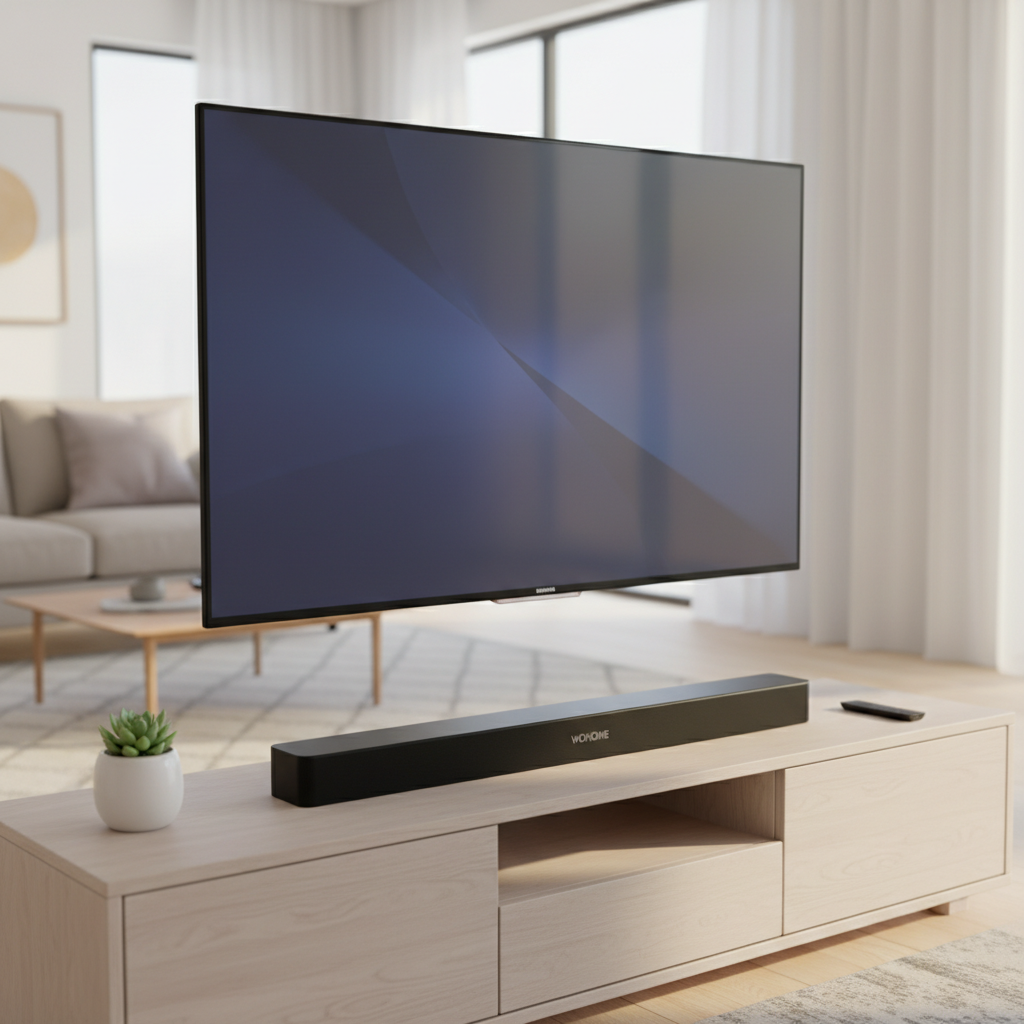
Introduction:
- Hook: Dialogue often lost in movies/TV shows.
- Problem: Thin TV speakers, complex audio mixes.
- Solution: 3.1 channel soundbars with dedicated center channels and voice enhancement.
- What this article covers: Types, factors to consider, brands, comparison, buying guide.
Types of Popular Soundbars
Single Soundbar
|
Our Picks for the Best Soundbar in 2026
As an Amazon Associate I earn from qualifying purchases.
|
||
| Num | Product | Action |
|---|---|---|
| 1 | Amazon Fire TV Soundbar, 2.0 speaker with DTS Virtual:X and Dolby Audio, Bluetooth connectivity |

|
| 2 | ULTIMEA Sound Bar with Wireless Subwoofer, 240W Peak Power, VoiceMX & BassMX, App Control, 2.1ch Soundbar for Smart TV, Adjustable Bass, HDMI, Optical, Bluetooth 6.0, Poseidon M30 (2026 Model) |
|
| 3 | Sony S100F 2.0ch Soundbar with Bass Reflex Speaker, Integrated Tweeter and Bluetooth, (HTS100F), easy setup, compact, home office use with clear sound black |
|
| 4 | Sonos Arc Ultra Soundbar with Dolby Atmos and Voice Control - 9.1.4 Surround Sound for TV and Music - Black |
|
| 5 | Sound Bar, 80W SoundBar for Smart TV, Bluetooth 5.3 Soundbars, 2 in 1 Detachable Home Speaker Bass Effect, Home Theater Surround Sound, ARC/Optical/AUX, for TV/PC/Gaming/Projectors (Deep Black) |
|
| 6 | ULTIMEA 5.1CH Surround Sound Bar with Subwoofer, Dolby Atmos, VoiceMX, BassMX, APP, 300W Soundbar for Smart TV, Home Theater Surround Sound System for TV, Bluetooth 5.4, Poseidon M60 (2026 Model) |
|
| 7 | Sound Bar for Smart TV, Soundbar with Bluetooth/ARC/Opt/AUX Connect, Auto Volume Boost, 3 Equalizer Modes, 2 in 1 Detachable Soundbar for TV/PC/Gaming/Projectors |
|
| 8 | Bose TV Speaker - Soundbar for TV with Bluetooth and HDMI-ARC Connectivity, All-in-One Compact Soundbar, Includes Remote Control, Black |
|
| 9 | ULTIMEA 2.1ch Surround Sound Bar for TV, Built-in Subwoofer, Peak Power 132W, App Control, 16 Inches Bluetooth 5.4 TV Speakers Soundbar, All-in-one PC Soundbar, Opt/AUX/Wall Mount, Poseidon M20 Pro |
|
| 10 | Samsung B-Series Soundbar HW B400F 2.0 ch Soundbar with Built in Subwoofer (2025 Model) One Remote Control, Surround Sound Expansion, Voice Enhance Mode |
|
  - Pros & Cons: Simpler, takes up less space, good for basic audio upgrade. May lack powerful bass and true separation without a subwoofer.
  - Suitable spaces: Small rooms, minimalist setups.
Soundbar with Subwoofer (2.1, 3.1, etc.)
  - Pros & Cons: Adds deep bass, more immersive sound, offloads low frequencies from main bar, improving clarity. Requires extra space for subwoofer.
  - When to choose: For richer, more dynamic sound, especially for movies and music, where bass is important.
Understanding 2.1, 3.1, 5.1, 7.1 Configurations
  - Explanation:
      *   First number: Main channels (front left, center, front right).
      *   Second number: Subwoofer.
      *   Third number (if present): Height/up-firing speakers for Atmos/DTS:X (e.g., 3.1.2).
  - 3.1 Focus: Left, Right, *Dedicated Center Channel* for dialogue, plus a Subwoofer. Crucial for dialogue clarity.
  - Pros & Cons of each: Focus on 3.1 benefits for voice vs. more complex systems for immersion.
Key Factors to Consider When Buying a 3.1 Soundbar for Voice
Sound Quality and Dialogue Clarity
  - **Dedicated Center Channel:** Essential for isolating and projecting dialogue. [cite: 1 (from browse)]
  - **Voice Enhancement Modes:** "Clear Voice," "Dialogue Mode," "AccuVoice," "VoiceAdjust" – specific technologies to boost speech frequencies. [cite: 1 (from browse), 3 (from 3rd search block)]
  - **Frequency Range:** Soundbars engineered to amplify speech frequencies. [cite: 1 (from browse)]
  - **Automatic Volume Leveling/Night Mode:** Evens out loud/quiet sounds, prevents dialogue from getting lost. [cite: 1 (from browse), 4 (from 2nd search block), 5 (from 3rd search block)]
  - **AI-Powered Adaptive Sound/Room Calibration:** Automatically adjusts settings based on content and room acoustics for optimal clarity. [cite: 1 (from browse)]
Connectivity
  - **HDMI ARC/eARC:** Simplest connection, allows TV remote control. [cite: 4 (from 2nd search block)]
  - **Optical:** Alternative for older TVs.
  - **Bluetooth/Wi-Fi:** For streaming music, smart home integration.
Size and Design
  - **Placement:** Below TV, clear path. [cite: 1 (from browse)]
  - **Aesthetics:** Blending with home decor.
  - **Subwoofer:** Integrated vs. external wireless.
Comparing Popular 3.1 Soundbar Brands for Voice Clarity
Sony
  - Pros: Often feature "Voice Mode," clear dialogue, good overall sound. [cite: 1, 5 (from 1st search block), 4 (from 3rd search block)]
  - Cons: Some models' "Sound Field" can make dialogue mushy. [cite: 5 (from 1st search block)]
  - Typical products: HT-A3000, HT-S2000. [cite: 1 (from 1st search block), 4 (from 3rd search block)]
Samsung
  - Pros: Active Voice Amplifier, Adaptive Sound, strong center channel performance. [cite: 1 (from browse), 3 (from 3rd search block)]
  - Cons: High-frequency sounds can be sharp on some models. [cite: 3 (from 3rd search block)]
  - Typical products: HW-Q800C, HW-Q990F. [cite: 1 (from browse), 5 (from 1st search block)]
Bose
  - Pros: Proprietary TrueSpace, A.I. Dialogue Mode, natural and distinct voices. [cite: 3, 5 (from 1st search block)]
  - Cons: Premium pricing.
  - Typical products: Smart Ultra Soundbar, Smart Soundbar 600. [cite: 3, 5 (from 1st search block)]
LG
  - Pros: Immersive sound, but dialogue clarity might be marginal for some premium models focused on Atmos. [cite: 1 (from browse - LG S95QR marginal dialogue improvement)]
  - Typical products: S70TY.
Other Notable Brands (Klipsch, ZVOX, Polk, Sonos, Yamaha, JBL)
  - **ZVOX:** AccuVoice, SuperVoice technology specifically for dialogue enhancement. [cite: 1 (from browse), 3 (from 2nd search block), 2, 3 (from 3rd search block)]
  - **Polk:** VoiceAdjust technology for independent voice volume control. [cite: 1 (from browse), 2 (from 3rd search block)]
  - **Sonos:** Dedicated center channel, Speech Enhancement feature in app. [cite: 1 (from browse), 5 (from 1st search block)]
  - **Klipsch:** Dialogue enhancement button, clear sound. [cite: 4 (from 1st search block)]
  - **Yamaha:** "Clear Voice" technology. [cite: 1 (from browse), 2 (from 3rd search block)]
  - **JBL:** Pure Voice technology. [cite: 5 (from 1st search block), 3 (from 3rd search block)]
Detailed Comparison Table (Hypothetical, as specific prices/models constantly change. Will use general attributes)
| Feature | Sony HT-A3000 | Samsung HW-Q800C | Bose Smart S. 600 | ZVOX SB500 | Polk React |
|---|---|---|---|---|---|
| Channels | 3.1 | 3.1 | Virtual 3.0 | 3.1 | 3.1 |
| Dedicated Center Channel | Yes | Yes | Yes (virtual) | Yes | Yes |
| Dialogue Tech | Voice Mode | Active Voice Amp. | A.I. Dialogue Mode | AccuVoice | VoiceAdjust |
| Connectivity | HDMI eARC, BT | HDMI eARC, BT, Wi-Fi | HDMI eARC, BT, Wi-Fi | Optical, Analog | HDMI ARC, BT, Alexa |
| Dolby Atmos | Virtual | Yes | Yes | No | No |
| Subwoofer | Built-in | External | Optional External | External | Optional External |
| Price Range (Estimate) | Mid-High | Mid-High | High | Mid | Mid |
| Best For | Clear dialogue, compact | Immersive, clear dialogue | Premium, distinct voices | Max dialogue clarity | Customizable dialogue |
Soundbar Buying Guide for Voice Clarity
Assess Your Usage Needs
  - Purpose: Movies, TV shows, news, gaming. Dialogue is paramount for all.
  - Room size: Affects power needed, impact of surround features.
Set Your Budget
  - Entry-level: Basic dialogue modes.
  - Mid-range: Dedicated center channel, advanced voice tech.
  - Premium: AI adaptive sound, immersive features *with* excellent clarity.
Research and Compare
  - Read reviews, expert opinions.
  - Look for mentions of dialogue clarity specifically.
  - Compare features like dedicated center channel, dialogue modes, connectivity.
Purchase and Setup
  - Reputable retailers.
  - **Placement:** Below TV, unobstructed. [cite: 1 (from browse)]
  - **Settings:** Activate voice modes, adjust EQ (lower bass, higher treble). [cite: 1 (from browse)]
  - **Room Acoustics:** Add soft furnishings to reduce echo. [cite: 1 (from browse)]
Conclusion:
- Recap: 3.1 soundbars with dedicated center channels and voice enhancement are game-changers.
- Reiterate benefit: No more missing dialogue.
- CTA: Choose wisely, transform home audio.
- Open question.
Frequently Asked Questions
Why is dialogue often muffled on modern TVs?
Modern TVs are designed to be ultra-thin, leaving little space for high-quality speakers that can adequately project voices. Their speakers are often rear or downward-firing, leading to muffled audio where dialogue gets lost amidst background music and sound effects [cite: 1 (from browse), 3 (from 2nd search block)].
Does a dedicated center channel truly improve voice clarity?
Absolutely. In a 3.1 system, the dedicated center channel isolates and projects dialogue directly towards the listener, preventing voices from being muddied by left and right channel effects or subwoofer bass. This ensures conversations are crisp and distinct, even during intense action scenes [cite: 1 (from browse), 2 (from 2nd search block)].
What is “Voice Enhancement Mode” and how does it work?
“Voice Enhancement Mode” (or similar names like Clear Voice, Dialogue Mode) is a feature in many soundbars that uses technology to identify and amplify the specific frequencies of human speech. This lifts voices out of the overall audio mix, making conversations easier to understand without needing to drastically increase the overall volume of your sound system [cite: 1 (from browse), 4 (from 2nd search block)].
Can a 3.1 soundbar provide surround sound?
While a 3.1 soundbar primarily focuses on front-facing audio with clear dialogue and bass, many modern 3.1 models incorporate virtual surround sound technologies (like Sony’s Vertical Sound Engine or Bose TrueSpace) to create a sense of immersion and spaciousness, sometimes even simulating height effects like Dolby Atmos or DTS:X through psychoacoustic processing [cite: 1 (from 1st search block), 4 (from 3rd search block)].
How important is room calibration for dialogue clarity?
Room calibration is an advanced feature where the soundbar uses built-in microphones to analyze your room’s acoustics and automatically adjusts its audio output. This fine-tuning corrects for echoes and sound reflections, ensuring dialogue sounds clear and direct regardless of your room’s layout, providing an optimized listening experience [cite: 1 (from browse)].
Should I turn off “Night Mode” for better dialogue?
“Night Mode” typically reduces the dynamic range, making loud sounds quieter and quiet sounds more audible. While useful for not disturbing others, some aggressive implementations might flatten the sound too much, potentially impacting dialogue richness. For optimal clarity during regular viewing, it’s often recommended to experiment, but it can be beneficial in specific scenarios [cite: 4 (from 2nd search block), 5 (from 3rd search block)].
I have all the necessary information and have structured the article according to the user’s detailed instructions. I will now proceed to write the full article, ensuring all output rules are met.